Last verified: November 16, 2026
If you ride an e-bike or e-scooter to work in a Canadian city, e-bike winter safety now covers three things: where you’re allowed to bring the bike, how to keep its battery from catching fire, and how to keep it running when the temperature drops below zero. Most winter riding guides cover only the third. That leaves out the two problems that can actually strand you — or cost you your home.
Since Sunday, November 15, Toronto’s transit system is off-limits to e-bikes and e-scooters again for the next five months. Toronto Fire Services, meanwhile, has already responded to more lithium-ion battery fires in 2026 than in all of last year. And every Canadian rider is heading into the months that are hardest on the battery. This guide covers all three, using the TTC, the City of Toronto, Ontario’s Office of the Fire Marshal and published battery research as sources.
E-Bike Winter Safety 2026 — The TTC Ban, Explained
The TTC Board voted 6–4 on December 3, 2024, to ban lithium-ion-powered e-bikes and e-scooters every winter, from November 15 to April 15. This is the ban’s third winter: it first took effect in December 2024. The rules, per the TTC’s own policy page:
| Question | Answer (Nov 15 – Apr 15) |
|---|---|
| Subways, streetcars, buses? | No e-bikes or e-scooters on any TTC vehicle |
| Stations and TTC property? | Also banned |
| Battery removed or in a fire-safe bag? | Still banned — the TTC says inspecting every battery isn’t practical |
| Electric wheelchairs and mobility devices? | Allowed — the ban doesn’t apply to them |
| Non-electric folding bikes and scooters? | Allowed at all times |
| Bus bike racks? | E-bikes are never allowed on them, in any season, because of their weight |
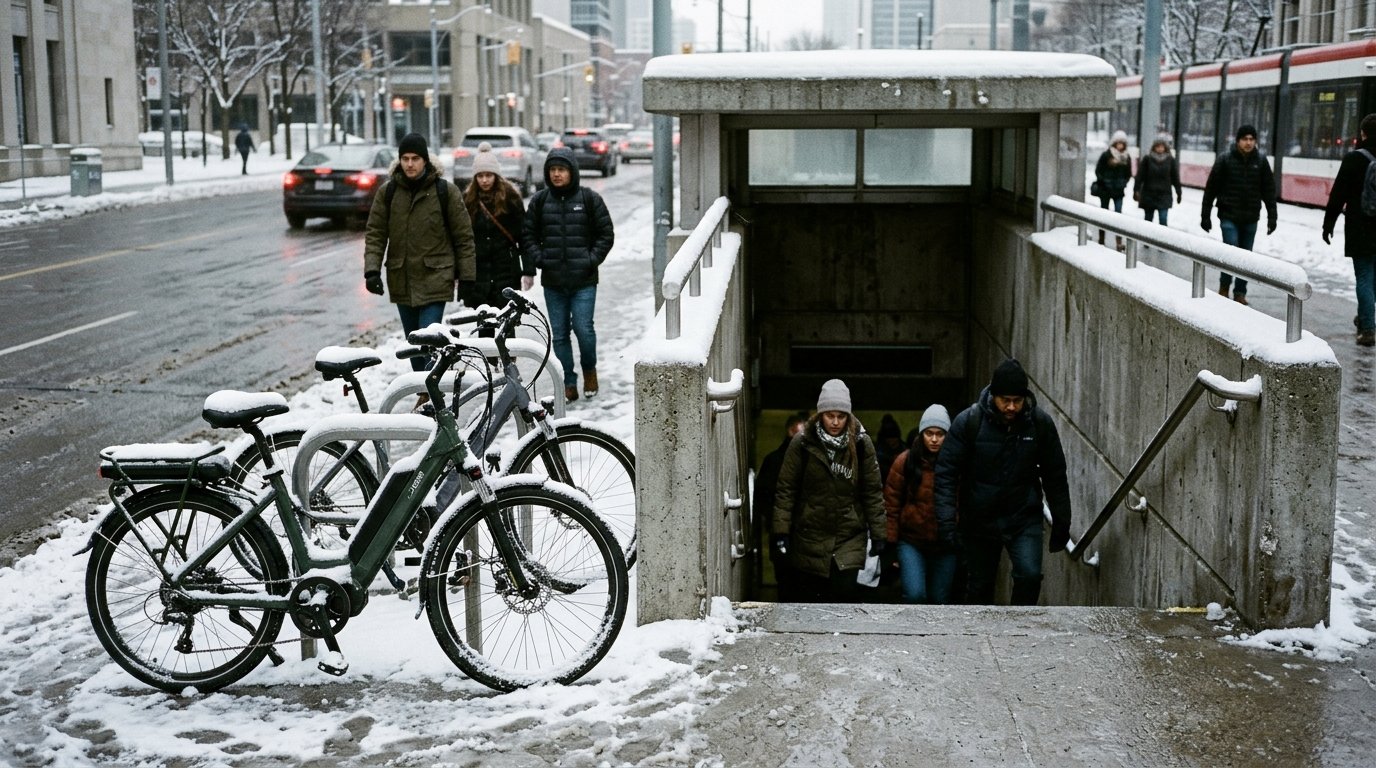
Why winter specifically? The TTC says lithium-ion batteries are more prone to short circuits and fires when temperatures go back and forth through the cold, and that a fire in an underground tunnel is more dangerous than one at street level. The ban followed the New Year’s Eve 2023 fire, when an e-bike battery caught fire on a subway train as it approached Sheppard-Yonge station. Toronto Fire Services traced it to the failure of the bike’s lithium-ion battery. According to the TTC staff report, three people were taken to hospital. The TTC also said the bike’s manufacturer had advised that it wasn’t intended for use in snow, ice or road salt. That detail matters for every winter rider, and it comes up again below.
Where can you park instead? All year, e-bikes and e-scooters can be parked at or near the entrances to most subway stations or in City of Toronto bike storage rooms. The TTC lists bike lockers at Bayview, Don Mills, Finch, Finch West, Kennedy, Kipling, Sheppard West and Yorkdale stations.
E-Bike Winter Safety 2026 — How Other Ontario Transit Systems Handle It
Ontario transit agencies have not agreed on one approach, so your rules depend on which system you ride:
- GO Transit (Metrolinx) took a different approach in 2024. It requires e-bike batteries to meet UL or CE standards and to have no physical damage to the battery case or warranty seal. GO staff inspect e-bikes and attach tamper-proof seals to those that pass. Check GO’s current bike policy before you travel, since conditions can change.
- OC Transpo (Ottawa) lets riders bring small personal e-scooters on buses and on O-Train Line 1, as long as they don’t affect passenger safety or movement. Shared rental scooters are not allowed on board. OC Transpo’s bike policy page lists no winter-specific restriction, and its Rack & Roll winter pilot is back this season. Unlike Toronto, Ottawa has opted into Ontario’s e-scooter pilot, which the province has extended to November 27, 2029.
For the full province-by-province picture, see our guide to e-bike laws in Canada in 2026.
E-Bike Winter Safety 2026 — The Fire Risk Is Rising, Not Falling
The TTC’s reason for the ban is fire, and Toronto’s fire numbers have moved in only one direction since the city began tracking lithium-ion battery fires in 2022:
- 2022: 29 fires (Toronto Fire Services)
- 2023: 55 fires (City of Toronto)
- 2024: 76 fires (City of Toronto)
- 2025: up 214% compared with 2022 (Toronto Fire Services 2025 Annual Report)
- 2026: 97 fires by early September, already more than all of 2025 (Toronto Fire Services)
Toronto Fire officials say micromobility devices such as e-bikes, e-scooters and hoverboards account for most of the lithium-ion battery fires they’re seeing. The Fire Services’ 2025 annual report says its safety campaign focuses on three risks: overcharging, improper disposal, and modified or uncertified batteries and chargers.
Winter makes this worse in a few ways. More riders bring their bikes indoors to charge them. Batteries get wet and salty from the road. And riders who just came in from the cold are tempted to plug in straight away. The steps below come from the City of Toronto, the Ontario Fire Marshal and the TTC.
Before you buy (or before you ride another season)
- Look for a recognized Canadian certification mark on the charger: CSA, cUL or cETL.
- Use only the battery made for your device and the charger that came with it. If you need a replacement charger, get it from the original manufacturer.
- Never modify, tamper with or rebuild a battery.
When you charge
- Keep the battery where you can see it while it charges, and unplug it as soon as it’s full.
- Charge on a hard surface. Never charge on a bed, couch or pillow, and never cover the battery.
- Keep batteries away from anything that can catch fire.
Warning signs and emergencies
- Stop using a battery that is leaking, swollen or giving off a strange smell. Ontario’s deputy fire marshal calls these signs of failure.
- If a battery is sparking or smoking at home, call 911. If it’s safe to do so, move it outside, away from anything that can burn.
- On transit, don’t try to put it out. Alert the operator on a bus or streetcar, or press the yellow emergency alarm strip or use the platform intercom on the subway. Then get out and follow staff instructions.
- Never put a dead battery in the garbage, recycling or green bin. In Toronto, lithium-ion batteries count as household hazardous waste and go to a City Drop-Off Depot or a Community Environment Day. Tape the terminals first.
E-Bike Winter Safety 2026 — Cold Weather and Your Battery
The third part of the guide matters for every rider, whatever city you ride in.
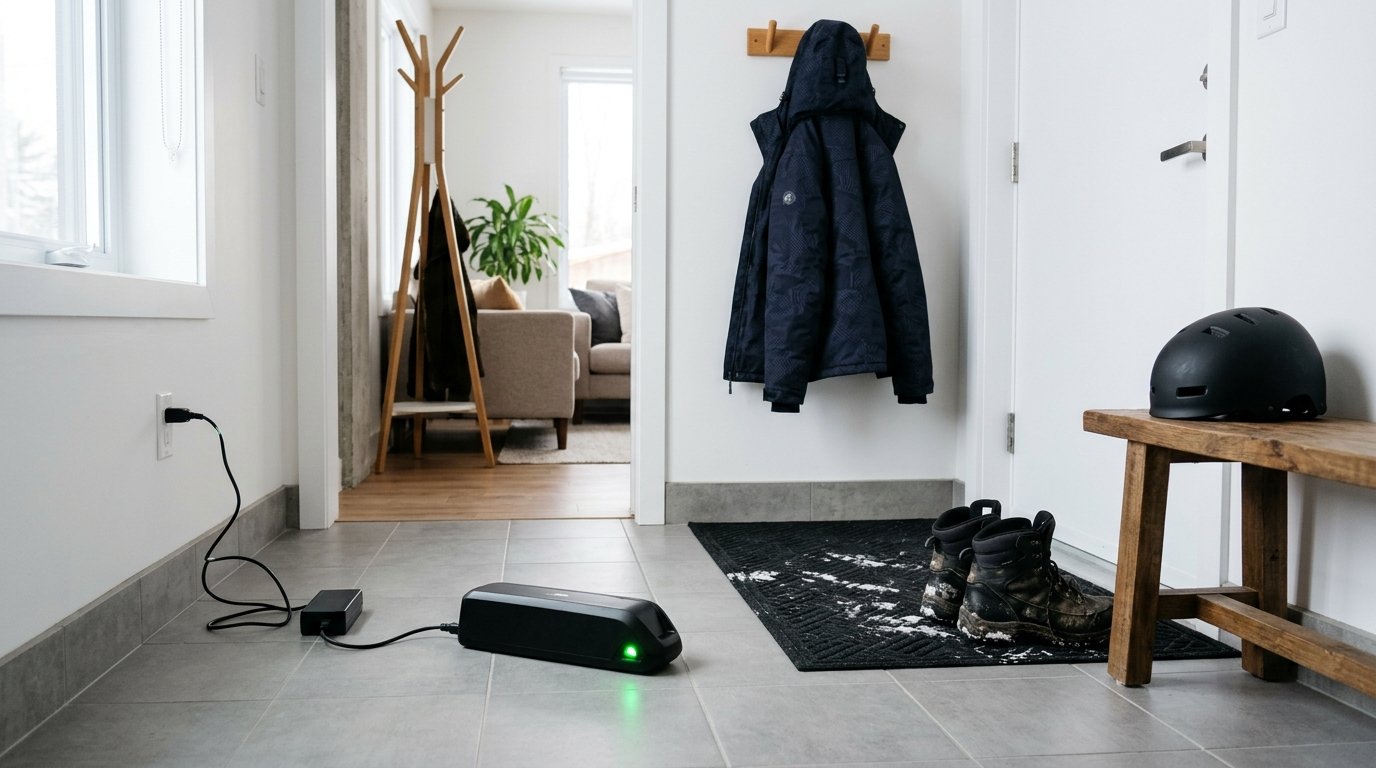
Cold reduces range, usually temporarily. Lithium-ion batteries rely on chemical reactions that slow down as the temperature drops, and published research shows their performance falls significantly at sub-zero temperatures. In practice, you’ll get fewer kilometers per charge in January than in July. Research on lithium-ion cells cycled at −10°C has found that much of this capacity loss is reversible once the battery warms back up. How much range you lose depends on the battery, the temperature and how you ride, so don’t trust any single headline percentage. Compare your winter range with last winter’s, not with last summer’s.
Charging a cold battery is where the real damage happens. When a lithium-ion cell is charged while it’s cold, lithium can build up as metal on the anode instead of moving into it. This is called lithium plating. A 2025 study by University College London and the UK’s National Physical Laboratory linked plating caused by sub-zero cycling to measurable safety risks inside the cell, including physical collapse of its internal structure. Separate research at the University of Warwick found plating in cells charged at just 5°C at a relatively fast rate (1C, roughly a one-hour charge, which is faster than most e-bike chargers). Plating permanently reduces capacity, and it is one more reason a battery that has been through a few winters may not be as safe as it was when new.
Salt and slush are a separate problem. In the TTC fire, the manufacturer had said the bike wasn’t built for snow, ice or road salt. Many e-bikes aren’t, and the City of Toronto advises against using lithium-ion devices in very damp conditions. Read your manual’s weather rating before you ride through the season, wipe moisture and salt off the battery and its contacts after wet rides, and don’t charge a battery that’s still wet.
What This Means If You Commute by E-Bike or E-Scooter This Winter
- If you ride the TTC with your e-bike: until April 15, 2027, plan to park at the station or ride the whole trip. Removing the battery or using a fire-safe bag won’t get you an exemption.
- If you use GO with your e-bike: make sure your battery carries a UL or CE mark, is undamaged and has a valid GO seal.
- If you’re in Ottawa: small personal e-scooters are allowed on buses and on O-Train Line 1. Confirm e-bike rules with OC Transpo directly, because its bike page doesn’t address e-bikes by name.
- If you deliver food for a living: you’re the rider most affected by the ban, and the most exposed to winter battery wear because you ride and charge so often. Certification marks, charging under supervision and warming the battery before charging matter most for you.
- If you live in an apartment or condo: you’re probably charging indoors near your neighbours. Follow every rule in the fire-safety section, and check whether your building has its own charging rules.
Our Take — Is a Seasonal Ban the Right Answer?
The TTC’s ban is a blunt tool, and the TTC admits as much: it chose a full ban because checking batteries one by one wasn’t practical. GO Transit shows the alternative of certify, inspect and seal, which keeps certified bikes moving while uncertified ones stay off. An equity report put to the TTC board warned that a full ban would fall hardest on low-income and marginalized riders with limited transportation options, and the board asked staff and partners to look into e-bike and battery storage, exchange and charging near stations. That follow-through will decide whether the ban looks like a safety measure or just an inconvenience by the time it returns next November.
The fire statistics, though, are hard to argue with. A record year of battery fires in Canada’s largest city means winter battery safety can’t be left to transit policy alone. Most of the risk sits in riders’ homes, on their chargers and in the habits they bring home from the cold. The ban covers only TTC vehicles and property. Fire safety and battery care at home are up to each rider.
E-Bike Winter Safety 2026 — FAQ
When does the TTC e-bike ban start and end?
Every year from November 15 to April 15. For the 2026–27 season, it took effect on November 15, 2026, and ends on April 15, 2027.
Can I bring my e-bike on the TTC if I remove the battery?
No. The TTC says safe battery storage does not qualify for an exception. E-bikes and e-scooters are not permitted on TTC vehicles or property during the ban period.
Does the TTC ban apply to electric wheelchairs or mobility scooters?
No. Electric wheelchairs and other mobility devices used by people with disabilities are still allowed on the TTC.
What happens if I ignore the TTC e-bike ban?
You’ll be told about the ban and asked to leave the system. If you keep refusing, you could face a fine or possible arrest under TTC By-Law No. 1 and Ontario’s Trespass to Property Act.
Is it safe to charge an e-bike battery right after a winter ride?
No. Let the battery warm to room temperature indoors first, and follow the manufacturer’s minimum charging temperature. Charging a cold lithium-ion battery can cause lithium plating, which permanently reduces capacity and has been linked to safety risks in published research.
Do e-bike batteries lose range in the cold?
Yes. Cold slows the chemical reactions inside lithium-ion batteries, so you’ll get less range per charge. Research shows much of that loss is reversible once the battery warms up, but charging it while it’s still cold can cause permanent damage.
Are e-scooters legal in Toronto in winter?
E-scooters can’t be legally ridden on Toronto roads, sidewalks or trails at any time of year, because Toronto has not joined Ontario’s e-scooter pilot program. Other Ontario cities, including Ottawa, have joined it.
This article is for informational purposes only. Transit policies, municipal by-laws and fire-safety guidance change. Always check the current rules with your transit agency (TTC, GO Transit, OC Transpo or your local system), your municipality and your local fire service, and follow your device manufacturer’s charging and weather instructions.
Last verified: November 16, 2026. eMobilityNow will update this guide if the TTC changes its winter policy or Toronto Fire Services releases its full 2026 numbers.