Last verified: August 16, 2026 | Part 7 of the Global Micromobility Law Series — the finale
This wraps our Global Micromobility Law 2026 series. Over the past two months, we’ve covered e-bike and e-scooter law across six regions: Canada’s fragmented, province-by-province patchwork, Australia’s aggressive seize-and-crush crackdown, the USA’s 50-state (plus cities) layer cake, Europe’s single technical standard wrapped in 27 different rulebooks, Asia’s four genuinely unrelated national philosophies, and most recently, India’s national threshold paired with a fast-growing subsidy program. What did researching all six actually teach us?
Global Micromobility Law 2026 — The Comparison Table
Asia doesn’t share a single regional standard the way the EU does, so we’ve broken it out into its four countries below rather than compressing them into one row — that’s also why this table runs nine rows, not six. The “Licence needed?” column is color-coded: indigo = no licence for a compliant device, amber = no licence, but with exceptions or extra registration, red = a licence is required.
| Region / Country | Compliant threshold | Licence needed? | E-scooters treated separately? | 2026’s biggest move |
|---|---|---|---|---|
| Canada | 500W / 32 km/h (PAB) | No (except Quebec, 14–17) | Yes — no federal standard | Ontario’s proposed two-class e-bike rewrite |
| Australia | 250W / 25 km/h (EPAC) | Not yet (Queensland from Aug 2026) | No — same threshold | NSW/WA can seize and destroy non-compliant bikes |
| USA | 750W / 20mph (up to 28mph, Class 3) | No, except 11 states | Partial — cities layer extra rules | New Jersey scrapped the three-class system |
| Europe | 250W / 25 km/h (EPAC, EN15194) | No | Yes — set per country | Italy: helmet + plate + insurance all now mandatory |
| Japan | Treated as an ordinary bicycle (no set threshold) | No | Yes — separate licence-free scooter tier if compliant | “Blue Ticket” on-the-spot fines begin (Apr 2026) |
| China | 25 km/h (GB 17761-2024) | No | Yes — standalone e-scooters banned in Beijing/Shanghai | Helmets made mandatory for riders and passengers (Beijing, May 2026) |
| South Korea | 20 km/h (Personal Mobility category) | Yes — motorised bicycle licence, age 16+ | Yes — treated closer to a motorcycle than a bicycle | PM Safety Law mandates registration for every device |
| Singapore | 25 km/h (PAB: EN15194; PMD: UL2272) | No — but PAB and PMD must both be registered with the LTA | Yes — three distinct certified categories (PAB/PMD/PMA) | Owning an uncertified PMA is now its own offence |
| India | 250W / 25 km/h / 60kg (CMVR) | No | No — same threshold | PM E-DRIVE subsidy extended to March 2028 |
Global Micromobility Law 2026 — What Every Region Actually Agrees On
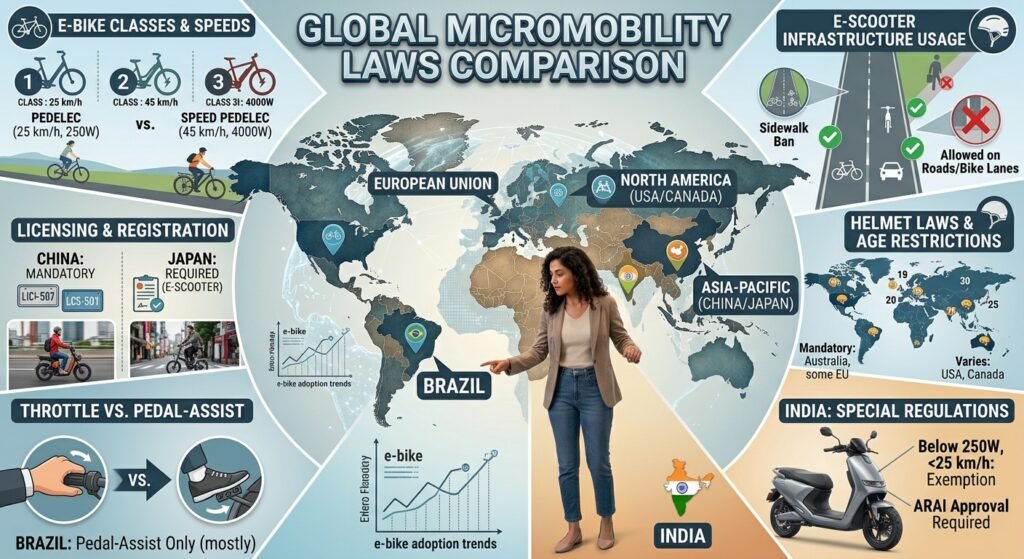
Strip away the specific numbers, and every single region in this series draws the same basic line: below a certain power and speed threshold, a two-wheeler is legally a bicycle — no licence, no registration, no insurance. Above it, the vehicle becomes something closer to a motorcycle or moped, with the paperwork to match. Canada calls the compliant device a Power-Assisted Bicycle. Europe and Australia call it an EPAC. Japan just calls it a bicycle. India doesn’t give it a special name at all — it’s simply a “low-speed electric vehicle” under the CMVR. Different vocabulary, same underlying idea.
What nobody agrees on is where that line sits. Europe, Australia, and India have all converged on roughly 250W and 25 km/h. Canada allows double the power (500W) and a higher speed (32 km/h). The US federal baseline allows 750W and permits Class 3 bikes up to 28mph. Japan doesn’t cap e-bike power in the same way at all — it just treats them as bicycles, full stop. There’s no sign of international convergence on a single number, even as more and more regions independently arrive at the idea that a number needs to exist.
Global Micromobility Law 2026 — Where They Sharply Diverge
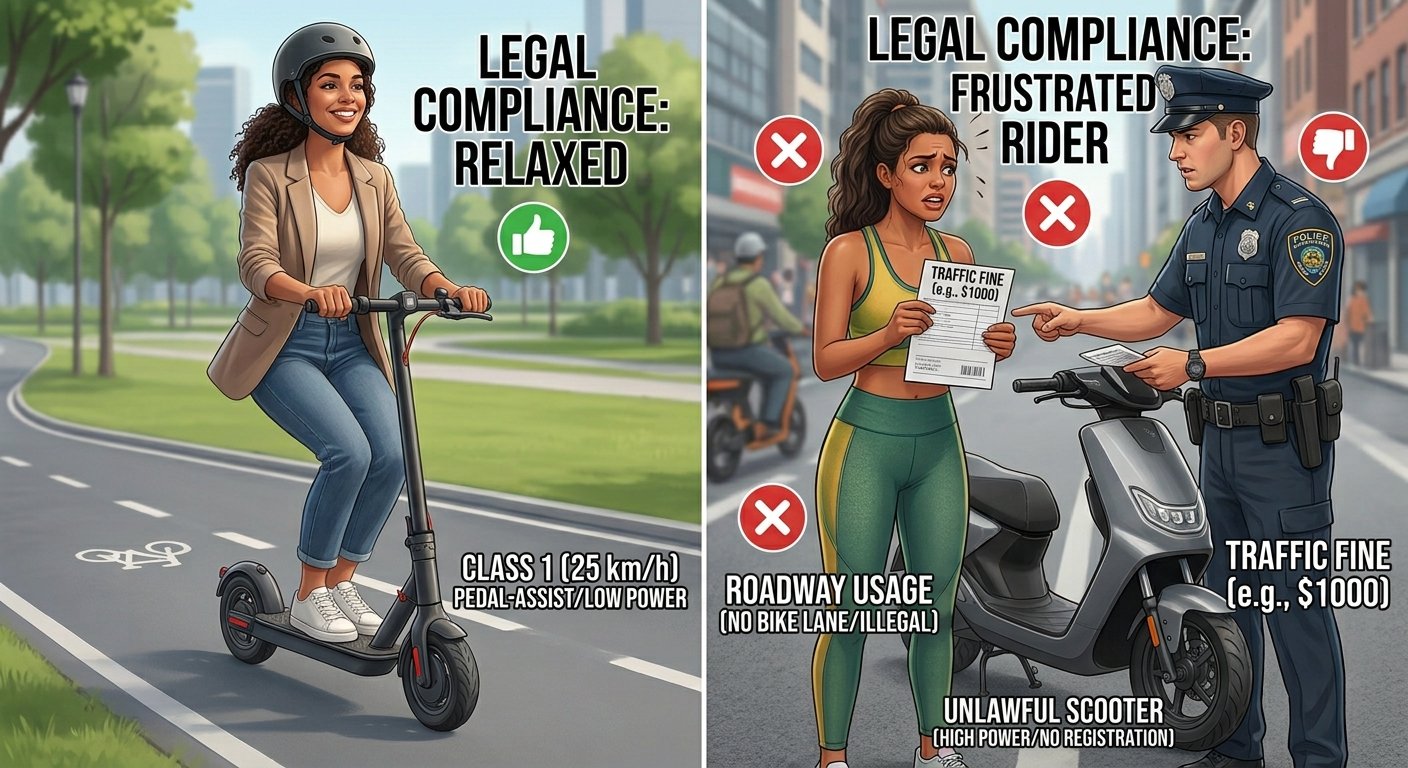
Two things separate these regions far more than the specific wattage number does: how e-scooters are treated, and how aggressively rules are enforced.
E-scooters almost never get the same treatment as e-bikes. Canada has no federal e-scooter standard at all, leaving every province to improvise — Toronto banned them outright while Ottawa runs a permitted pilot 20 minutes down the highway. Europe requires insurance and, in some countries, physical plates for scooters, while the identical-looking e-bike next to it needs neither. South Korea treats e-scooters almost like motorcycles, complete with a licence and a driving record that a DUI can put at risk. Singapore certifies e-scooters to an entirely different fire-safety standard than e-bikes and bans them from roads outright. China bans standalone electric scooters from Beijing and Shanghai’s streets while e-bikes remain core infrastructure. India and Australia are the exceptions here — both apply the same threshold to e-scooters as e-bikes, with no separate framework.
Enforcement intensity varies enormously, independent of how strict the rules on paper actually are. Toronto banned e-scooters twice and issued 89 tickets in an entire year in a city of three million people — a rule that exists mostly on paper. Compare that to New South Wales, where police now carry portable roadside “dyno” testing units, or Western Australia, where non-compliant e-bikes have already been seized and crushed for months — in both states, a confiscated bike carries no guaranteed right of return. The rules themselves aren’t always the story — whether anyone actually checks is often the bigger difference between regions.
Global Micromobility Law 2026 — The One Loophole Every Region Is Fighting
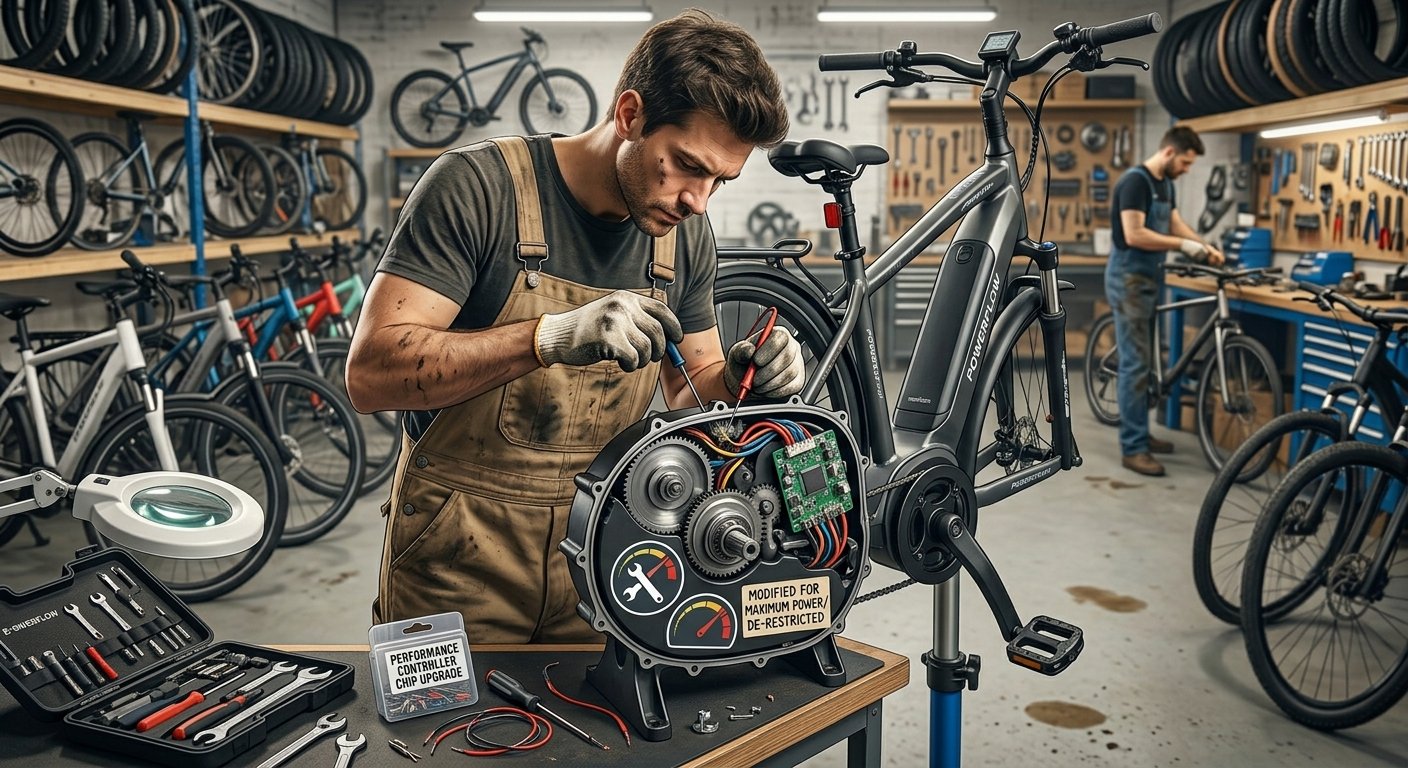
If there’s a single throughline connecting all six articles in this series, it’s this: every region is fighting the same loophole, using different words for it. Canada calls it the “750W trap” — bikes marketed as speed-limited that are still classified by their motor’s rated power, not its software cap. Europe calls it “débridage” or “tuning” — removing the 25 km/h limiter, which instantly voids warranty and insurance. Australia calls them “derestriction kits.” India’s problem is retrofitted or swapped controllers that let a “low-speed” scooter exceed 25 km/h in practice. In every single case, the underlying dynamic is identical: a device sold as compliant that isn’t actually ridden that way, and regulators racing to close the gap between what’s on the spec sheet and what’s on the road.
What This Means If You’re Buying an E-Bike or E-Scooter Anywhere in 2026
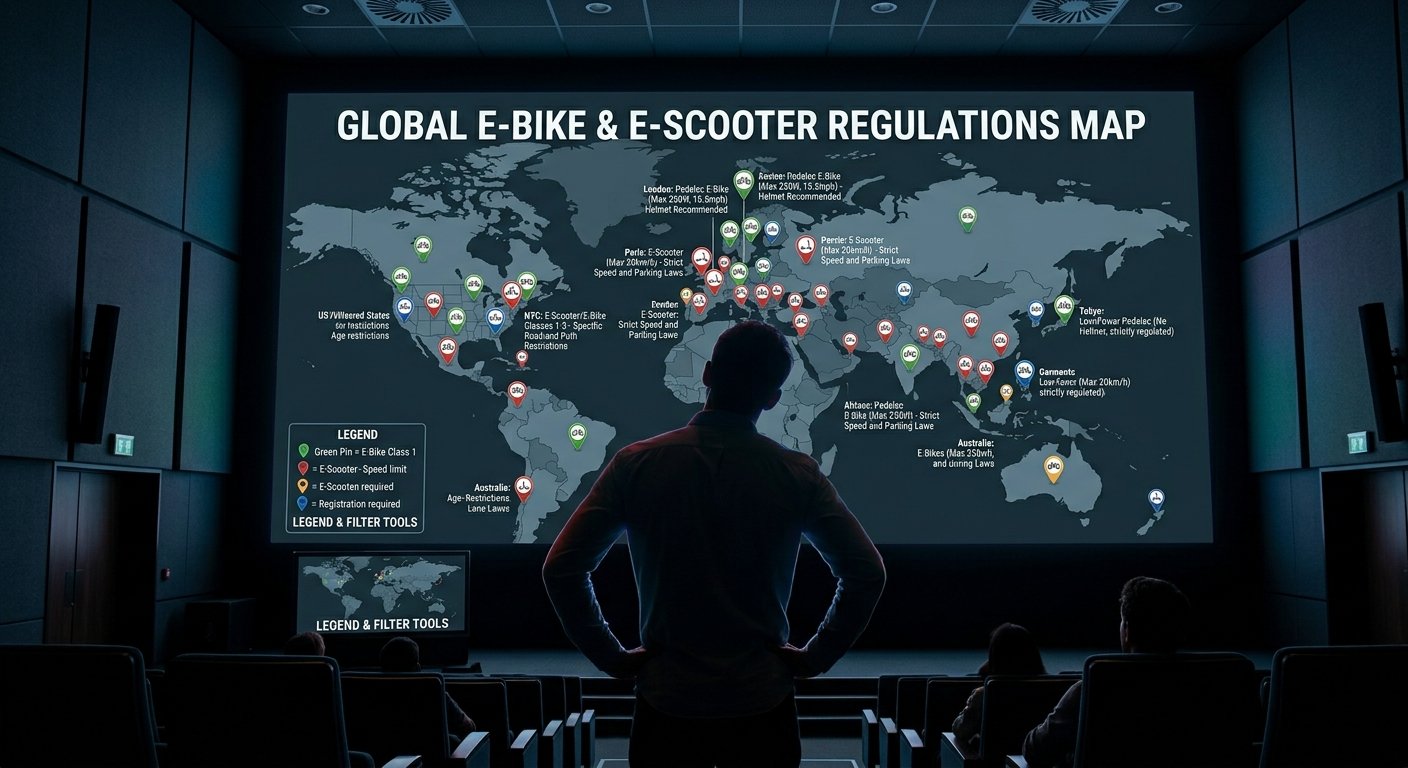
- The safest global default is the lowest common denominator: a pedal-assist-only e-bike under 250W that tops out at 25 km/h clears the bar almost everywhere in this series, India and Europe and Australia included. A 750W throttle bike bought in the US will very likely need a licence plate the moment it lands almost anywhere else.
- Check the motor’s rated output, not the marketing copy or the current speed-limiter setting — this is the single most repeated piece of advice across all six articles in this series.
- Treat e-scooters as a completely separate legal question from e-bikes — in most of the regions we covered, they are, even when they look and perform almost identically.
- Enforcement is trending up almost everywhere — Ontario, New Jersey, Queensland, NSW, Italy, Spain, Singapore, Beijing, and India’s own regulatory review of its power/weight caps all moved toward tighter rules or tighter enforcement in 2026. If a rule feels loosely enforced today, that’s not a reason to assume it stays that way.
Our Take — Six Regions Later, Who’s Actually Getting This Right?
Nobody has a perfect system, but the pattern that emerges from writing all six of these guides is that the regions doing best share one thing in common: a single national (or continental) technical standard, paired with road rules that are allowed to vary locally on top of it. Europe’s EN 15194 standard and Australia’s national convergence on 250W/25km/h both work this way — the vehicle definition is stable, even when helmet laws or insurance requirements differ by country or state. India’s CMVR framework follows the same logic. Canada is the clearest counterexample, since it never built a federal e-scooter standard at all and left every province to improvise on its own. The USA is a more particular case: it does have a stable federal technical definition, but 2026 showed that individual states can simply override it — New Jersey abandoned the three-class system entirely rather than layering rules on top of it, which is a different failure mode from Canada’s but arrives at a similar result for riders: the legal status of an identical vehicle can still flip depending purely on which side of a state or city line you’re standing on.
Australia’s crackdown is the most aggressive experiment in the series, and whether “seize and crush” turns out to be effective deterrence or mostly theatre is still an open question as of this writing. What’s harder to argue with is the data behind it — 12 deaths and 6,300 injuries in Queensland in a single year isn’t a manufactured panic. Whether other regions follow Australia’s enforcement intensity, or find a lighter-touch way to close the same compliance gap, is probably the thing worth watching most closely as this series’ six regions all continue updating their rules through the rest of 2026.
Global Micromobility Law 2026 — FAQ
Is there a single global standard for e-bikes?
No. The closest thing is the EN 15194 technical standard used across the EU, which Singapore also references for its Power-Assisted Bicycle category. But Canada, the US, China, Japan, South Korea, and India all use different power and speed thresholds, and none of the six regions in this series share an identical definition.
What’s the most common legal threshold for a compliant e-bike worldwide?
250 watts of motor power with assistance cutting off at 25 km/h is the most widely used threshold among the regions we covered — used by the EU, Australia, and India. Canada (500W/32km/h) and the US federal standard (750W/20mph) both allow meaningfully more power and speed.
Which region has the strictest e-bike and e-scooter enforcement?
Based on what we found researching this series, Australia — specifically New South Wales and Western Australia, where police can seize and permanently destroy a non-compliant e-bike on the spot, with no guaranteed right to get it back.
Which region has the most lenient e-bike laws?
Japan comes closest among the regions covered — a compliant e-bike is legally just a bicycle, with no licence, registration, or insurance required, and even its e-scooter framework includes a genuine licence-free tier for compliant devices.
Why do e-scooters get treated so differently from e-bikes almost everywhere?
Most e-scooters lack functioning pedals, which disqualifies them from the “power-assisted bicycle” legal category that gives compliant e-bikes their light-touch treatment in Canada, Europe, Singapore, and elsewhere. Without that pedal-based classification, regulators have generally had to build a separate framework from scratch for scooters — and each region has built a different one.
Is modifying or “de-restricting” an e-bike or e-scooter legal anywhere in this series?
No. Every region we covered treats exceeding the compliant power or speed threshold — however it happens — as an instant reclassification to motor-vehicle or moped status, typically voiding insurance and warranty coverage in the same moment.
This article synthesizes conclusions from our full Global Micromobility Law Series; each regional article linked throughout has its own full source citations and fact-checking notes. Laws referenced here change frequently in every region covered — always verify current requirements with the relevant local transport authority before riding or purchasing.
Last verified: August 16, 2026. This wraps our Global Micromobility Law Series — eMobilityNow will revisit this comparison as any of the six regions’ rules change materially.