E-Bikes & E-Scooters, Laws & Regulations / Fortis
Last verified: July 22, 2026 | Part 4 of the Global Micromobility Law Series
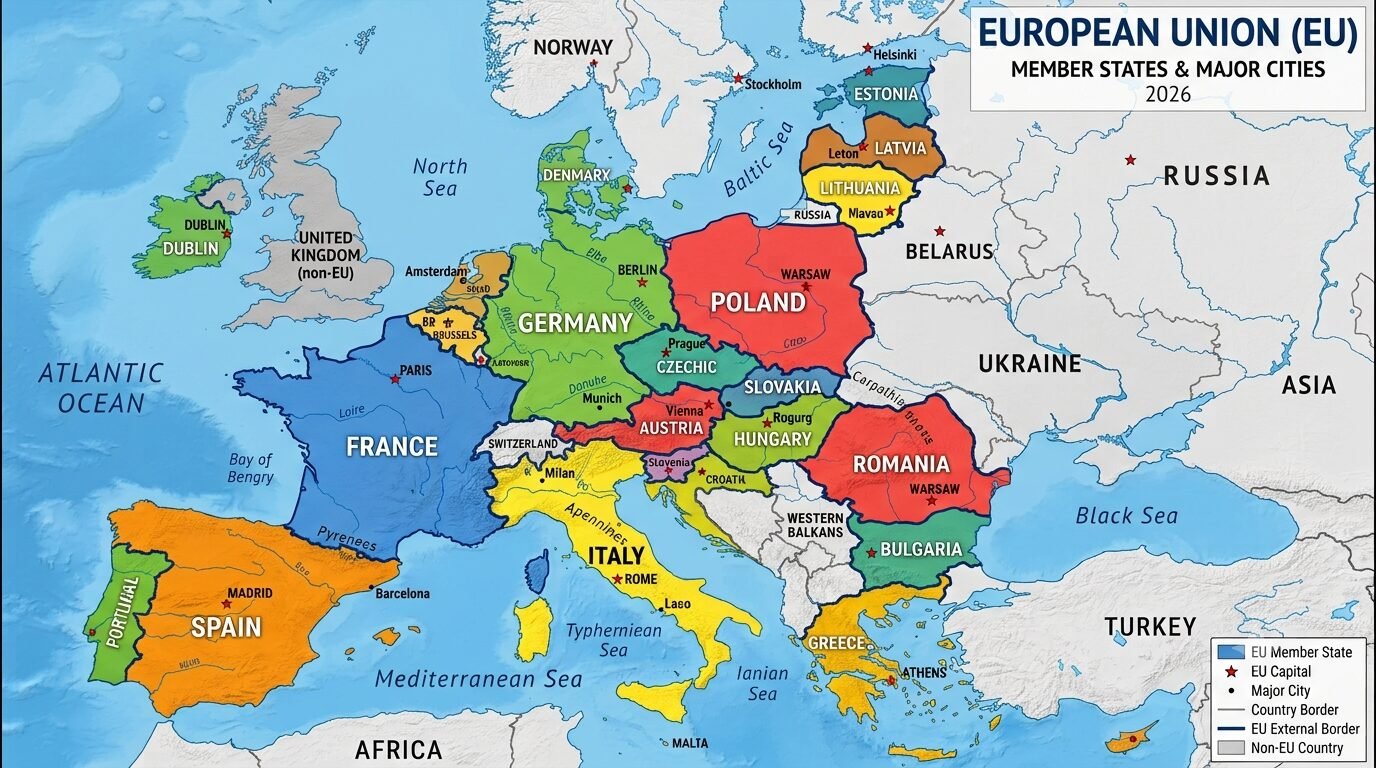
In Canada, Australia, and the USA, e-bike and e-scooter law is a patchwork of states and provinces, each writing its own definition of what counts as a bicycle versus a motor vehicle. E-bike and E-scooter laws in 2026 Europe work differently, and understanding that difference is the key to everything else in this guide. The European Union writes one technical rulebook that decides how an e-bike or e-scooter has to be built in order to legally count as something other than a motor vehicle. But the EU has almost nothing to say about how that vehicle is allowed to be ridden once it’s built — that part is left entirely to each of the EU’s 27 member states, and in many cases, to individual cities within those states.
The result is a strange kind of consistent inconsistency. A 250-watt e-bike that meets the EU’s technical standard is, on paper, identical whether you buy it in Lisbon or Warsaw. But whether that exact same bike needs a license plate, whether you can ride it on a sidewalk, whether you need a helmet, and what age you have to be to legally operate it — all of that can change completely the moment you cross a border, and sometimes the moment you cross a city line.
An e-scooter that’s perfectly legal to ride on the road in Paris can be functionally unridable in Amsterdam, not because it’s slower or less safe, but because the Netherlands requires individual model approval before any e-scooter is allowed on public roads at all.
This guide to e-bike laws Europe 2026, which travellers, buyers, and commuters actually need, walks through what’s the same everywhere and what varies by country, and why. It picks up where the rest of the Global Micromobility Law Series left off — after covering Canada, Australia, and the USA — and covers the core technical spec that defines a legal e-bike, the trap that catches buyers of popular American e-bikes, the country-by-country reality of e-scooter law, what insurance and paperwork you genuinely need, the safety rules enforcement actually checks for, and why removing your e-bike’s speed limiter causes more problems than it solves.
Why Europe Regulates E-Bikes and E-Scooters So Differently
To understand European micromobility law, it helps to understand why it’s structured the way it is. The EU’s founding purpose, when it comes to vehicles, is to make sure a product manufactured to a common standard can be sold and used across every member state without each country independently re-testing it. That’s what the technical standard — called EN 15194 — accomplishes for e-bikes. It defines a category called an EPAC: an Electrically Power Assisted Cycle, more commonly called a “pedelec” across most of the continent. An e-bike that meets the EPAC definition is, legally, a bicycle everywhere in the EU. Not a moped, not a motor vehicle — a bicycle, with all the freedom that implies: no license, no registration, no mandatory insurance.
But road traffic law — the rules about where vehicles can go, what safety equipment riders must carry, what age someone has to be to operate one — was never something the EU centralized. Those decisions sit with national governments, and in many countries, national governments have in turn pushed some of those decisions down to individual cities. That’s why an e-scooter can be built to a single European safety standard and still face five completely different rulebooks depending on which country’s roads it’s ridden on. The vehicle is standardized. The rider’s obligations are not.
What Makes an E-Bike Street Legal: The EPAC Rule
The EPAC standard comes down to three requirements, and all three have to be true simultaneously for a bike to qualify:
- 250W maximum continuous motor output — this is measured as sustained power, not peak power, which is why some bikes technically capable of higher short bursts still qualify.
- Motor assist cuts off at 25 km/h (15.5 mph) — and it has to cut off progressively as the bike approaches that speed, not abruptly. A motor that just switches off at exactly 25 km/h with no tapering fails certification.
- Pedal-assist only — the motor is only allowed to add power while the rider is actively pedaling. A throttle that propels the bike forward without any pedaling input disqualifies it from EPAC status, full stop.
Meet all three, and the trade-off is straightforward: you give up higher speed and throttle convenience, and in exchange you get to ride across nearly the entire EU with the same freedom as an ordinary cyclist. There’s one narrow exception built into the rule: EU regulation permits a “walk-assist” function, engaged by a switch rather than pedaling, that can push the bike up to 6 km/h — intended for walking a bike uphill or through a crowded area, not for riding it. That function doesn’t affect the bike’s EPAC classification, because it isn’t meant to be used while the rider is aboard and pedaling.
This is also where the single most expensive mistake in this entire guide comes from.
Speed Pedelecs (S-Pedelecs): The 45 km/h Middle Ground
Between a standard EPAC and a full moped sits a category called the S-Pedelec — a speed pedelec that assists up to 45 km/h (28 mph), nearly double the everyday pedelec limit. It exists because there’s real demand for it: commuters covering longer distances want more assisted speed than a standard EPAC provides, without stepping all the way up to a full motorcycle. But that extra speed comes at a legal cost. In almost every EU country, crossing the 25 km/h threshold reclassifies the bike as a moped, which brings a different set of obligations entirely:
- A moped insurance policy, rather than the no-insurance status of a standard EPAC
- A registration plate, which has to be visibly displayed
- A valid driver’s license — the specific category required varies by country, but it’s typically the same category that covers mopeds and light motorcycles generally
- An approved motorcycle-style helmet, which is a different, more protective standard than a typical bicycle helmet
S-Pedelecs are also frequently excluded from ordinary cycle paths. The reasoning is straightforward from a safety-planning standpoint: cycle paths were designed around the speed and behavior of ordinary bicycles, and a 45 km/h electric bike sharing that same narrow lane with a child on a pedal bike creates exactly the kind of speed mismatch that European traffic planners try to engineer away from. In practice, this makes the S-Pedelec a genuinely useful but fairly niche choice — it suits a long-distance commuter who specifically wants moped-level speed and is willing to take on moped-level obligations, but it’s a poor fit for anyone drawn to e-bikes for the license-free simplicity a standard EPAC offers.
E-Scooter Rules by Country: Where You Can Actually Ride
If e-bike law in Europe is a shared technical foundation with local variations layered on top, e-scooter law is closer to five separate countries that happen to agree on one thing: the sidewalk is off-limits. Beyond that single point of agreement, speed caps, insurance obligations, and plate requirements diverge sharply from one country to the next — and in some cases, they’ve changed dramatically within just the past eighteen months.
| Country | Max Speed | Min. Age | Insurance / Plate? | Sidewalk Riding? |
|---|---|---|---|---|
| Germany | 20 km/h | 14 | Yes — insurance sticker required | ❌ Strict ban |
| France | 25 km/h | 14 | Insurance required; plate not standard | ❌ Banned (€135 fine) |
| Netherlands | 25 km/h | 16 | Yes — must be RDW-approved + plate | ❌ Strict ban |
| Italy | 20 km/h | 14 | Yes — plate & insurance mandatory (€100–€400 fine) | ❌ Strict ban |
| Spain | 25 km/h | 15 (from Oct 2026) | Yes — insurance mandatory since Jan 2026; helmet & national age-15 rule from Oct 2026 | ❌ Strict ban |
| United Kingdom | 15.5 mph (~25 km/h) trial cap — lower in some cities (London: 12.5 mph) | No national minimum; set per scheme (London: 18+). Provisional licence (Cat. Q) required | No plate; private e-scooters can’t be insured at all — legal only via rental trials, insured by the operator | ❌ Banned everywhere — illegal on pavements nationwide, private or rental |
The broad takeaway is simple even where the details aren’t: riding on the pavement is illegal almost everywhere in Europe, and scooters are expected to use bike paths, or the road itself where no bike path exists. Here’s what that looks like country by country, and why each one ended up where it is.
Germany: Insurance Comes First, No Exceptions
Germany’s governing regulation, the Elektrokleinstfahrzeuge-Verordnung (eKFV), caps e-scooters at 20 km/h and 500W of motor power, and treats them as their own distinct vehicle category — legally separate from both bicycles and mopeds. Every scooter operating on German public roads needs a Versicherungsplakette, an insurance sticker renewed annually and visibly attached to the rear of the vehicle. This isn’t treated as a minor paperwork lapse if skipped. Riding without valid insurance is a criminal offense under German compulsory insurance law, not simply an administrative fine, and police departments in cities including Munich and Berlin have run dedicated spot-check operations specifically to catch uninsured scooters. For a visiting rider or a new resident, the insurance sticker is genuinely the single most important thing to sort out before riding at all.
France: No Plate Required, But the Rules Have Tightened Quickly
France classifies e-scooters as engins de déplacement personnel motorisés (EDPM) under a decree first issued in 2019, with a top speed cap of 25 km/h. Unlike Germany, France doesn’t require a physical plate for a privately owned scooter. But that relative simplicity shouldn’t be mistaken for looseness — the direction of travel over the past few years has been toward more restriction, not less. The minimum riding age rose from 12 to 14 in September 2023, specifically in response to a rise in accidents involving younger riders. Third-party liability insurance is mandatory for every rider. Sidewalk riding carries a €135 fine, and that fine rises sharply, to as much as €1,500, for a scooter that’s been tuned or de-restricted beyond its legal speed cap. Paris has gone further still, banning free-floating rental scooter services from the city entirely since 2023 — worth noting that this was a rental-market decision specifically, not a ban on owning and riding a personal scooter within city limits.
Netherlands: Assume It Isn’t Legal Until You’ve Checked
Of the five countries in this guide, the Netherlands takes the strictest starting position. The default assumption, for any e-scooter sold anywhere in Europe, should be that it is not approved for use on Dutch public roads — because most aren’t. To ride legally, a specific scooter model has to appear on an approved-device list maintained by RDW, the Dutch national vehicle authority, then be individually registered, and finally carry a physical plate in the same blue moped-style format used for the country’s 25 km/h mopeds, known locally as snorfiets. Riding an unapproved model isn’t a gray area — it risks both a fine and on-the-spot confiscation of the scooter. Riders also need to be at least 16 years old — the highest minimum age of any country in this guide — though no driving license is required for an approved scooter. One transition detail worth knowing: even scooter models that were already RDW-approved before the plate rule began were given until July 1, 2026 to fit their blue plate. That grace period has now closed, so the plate requirement effectively applies across the entire approved fleet, not just new models. This is the one country in this guide where the honest advice for most visitors and new arrivals is: don’t assume, check the RDW approved list before you ride.
Italy: The Fastest-Moving Rulebook in Europe
No country covered here has changed its e-scooter law faster than Italy over the past two years. Mandatory helmets for every rider, regardless of age, arrived in December 2024. Identification plates followed on May 16, 2026. Compulsory third-party liability insurance became law most recently, on July 16, 2026 — meaning that as of this article, Italy now has the complete package of helmet, plate, and insurance requirements all simultaneously in force, with fines of €100 to €400 and on-the-spot vehicle seizure for riders caught without them. Riding is also restricted to urban roads with a posted speed limit of up to 50 km/h, and scooters are explicitly excluded from both cycle paths and pedestrian areas. Standard 25 km/h pedal-assist e-bikes are explicitly exempt from this insurance mandate — it applies to scooters, not EPACs. For minors aged 14 and up, a parent or legal guardian has to submit the insurance and plate application on the rider’s behalf.
Spain: A Country Mid-Transition Right Now
Spain is worth watching closely through the rest of 2026, because its rules are actively in the middle of changing. Certification — proof that a scooter model meets the DGT’s technical manual — has applied to new sales since January 22, 2024, with a grace period for devices bought before that date extending to January 2027. Mandatory insurance arrived nationally on January 2, 2026. Then, layered on top of both of those, a broader reform approved by Spain’s Council of Ministers on June 23, 2026 adds two more requirements that don’t yet apply but will very soon: mandatory helmets for every rider, with no exceptions by age, and a single national minimum riding age of 15, replacing what had been a patchwork of different age limits set independently by individual municipalities. Both of those additions take effect on October 1, 2026.
United Kingdom: No Legal Path for Private E-Scooters
The UK’s e-bike rules are already covered above — EAPCs follow essentially the same 250W / 25 km/h standard as the EU, with no licence or insurance required. E-scooters are a different story, and the UK turns out to be the strictest market in this guide by a wide margin.
Unlike any of the five EU countries above, the UK has no legal category for a privately owned e-scooter at all. Insurers simply don’t offer a policy for one, and without insurance, riding one in public is illegal under the Road Traffic Act 1988 — regardless of how compliant the device itself is. The only way to ride an e-scooter legally in the UK is through a local council’s government-sanctioned rental trial, which caps speeds at 15.5 mph nationally (London’s trial runs slower, at 12.5 mph) and requires riders to hold at least a provisional driving licence. Pavements are off-limits to every e-scooter in the UK, rental or private, under a law that predates the e-scooter by more than 150 years. Those rental trials, running since 2020, were just extended for a fifth time — to May 2028 — while the government keeps gathering safety data before deciding whether to legislate a permanent framework.
Do You Need Insurance, a License, or a Plate?
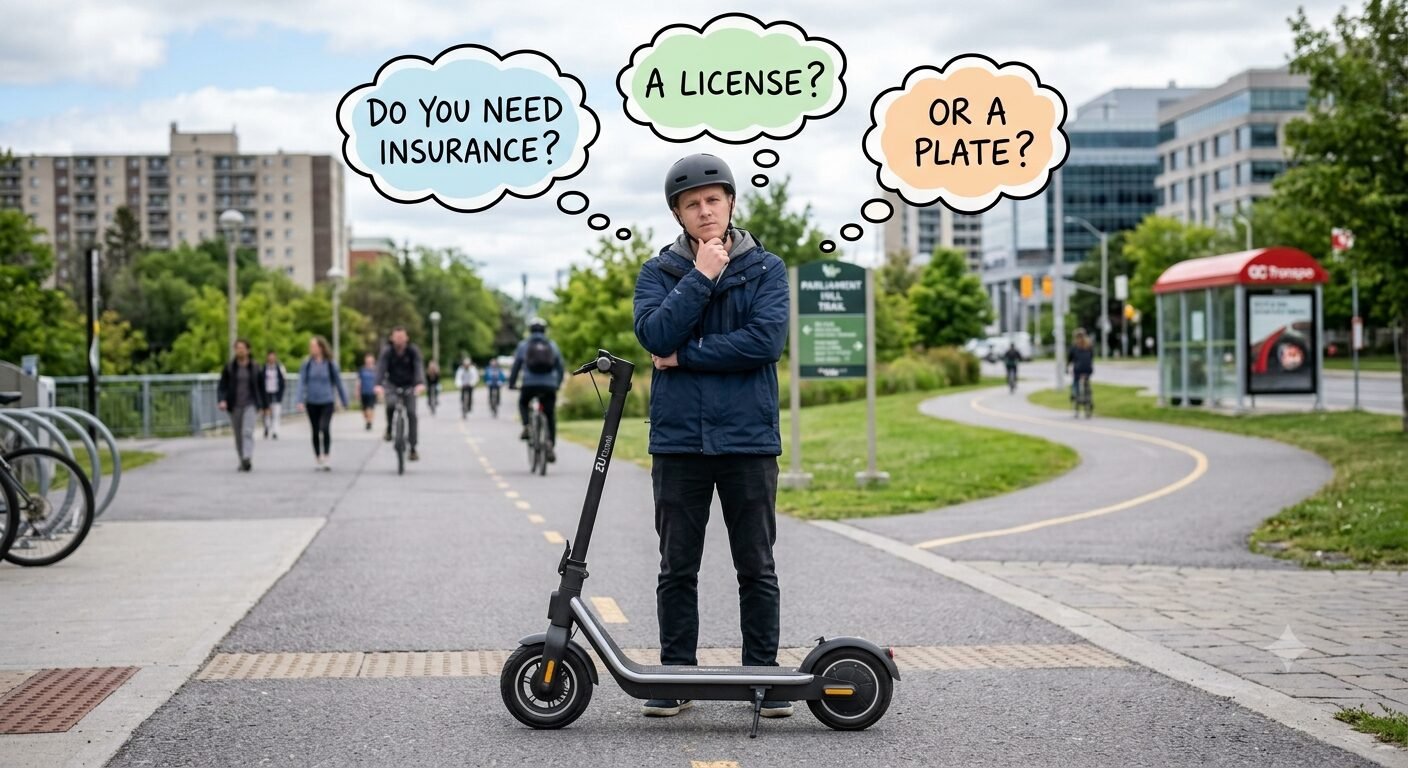
Every buyer eventually asks some version of this question, and the honest answer depends entirely on which of three categories the vehicle falls into.
A standard 250W, 25 km/h EPAC e-bike needs none of it — no license, no registration, and no mandatory insurance, anywhere in the EU or UK. That’s the whole point of meeting the EPAC standard in the first place. An e-scooter’s requirements are set entirely at the national level: Germany, Italy, the Netherlands, and, as of 2026, Spain all require a physical sticker or plate attached to the scooter itself, while France requires insurance without requiring a plate. And an S-Pedelec, or any e-bike that fails to meet EPAC requirements — including the US-import scenario covered earlier — is treated exactly like any other moped: insurance, plate, and license, all required, no exceptions carved out for the fact that it started life as something marketed as a bicycle.
The practical process of getting insured also varies more than people expect. In Germany, it’s genuinely simple: you buy a policy from any insurer offering the Versicherungsplakette insurance sticker, and the sticker itself functions as your proof of compliance — there’s no separate trip to a registration office required for a standard e-scooter. Spain and Italy work differently and involve more steps: first the scooter model has to be certified as meeting the national technical standard, then it has to be registered in a national vehicle database, and only after that registration is complete can insurance actually be issued against it. Anyone buying a scooter in either of those countries in 2026 should expect the full process — certification, registration, insurance — to take real time, not to be something handled at the point of sale.
Safety Mandates: Helmets, Age Limits, and Required Equipment
Helmets
Standard 25 km/h e-bikes rarely carry a legal helmet requirement for adult riders anywhere in Europe, though every national safety authority on the continent recommends wearing one regardless of what the law technically demands. E-scooters tell a different story, and one that’s actively moving toward stricter rules across the board. Italy has required helmets for every rider, regardless of age, since December 2024. France requires them for minors specifically, while leaving adult riders without a legal obligation. Spain currently leaves the decision to individual municipalities, which has produced a genuine patchwork of local rules — but that patchwork is being replaced nationally: a helmet requirement covering every rider, adult or minor, takes effect across all of Spain on October 1, 2026. And regardless of country, S-Pedelec riders need an approved motorcycle-style helmet everywhere in the EU, not the lighter bicycle-style helmet that suffices for a standard EPAC.
Age Limits
Minimum riding ages across Europe generally fall somewhere between 14 and 16 years old, though the exact figure and the vehicle categories it applies to differ by country. France raised its e-scooter minimum from 12 to 14 in September 2023, explicitly citing accident data involving younger riders as the reason. Germany’s minimum sits at 14 as well. The Netherlands sets the highest bar of any country covered here, at 16. Spain is in the process of moving away from a system where each municipality set its own age limit independently, toward a single national minimum of 15 that takes effect October 1, 2026. Below whichever minimum age applies, riding is typically still permitted on private land — a family’s own driveway or yard, for instance — but not on public roads or cycle paths.
Mandatory Hardware
Physical equipment requirements are one of the few areas where Europe is genuinely consistent from one country to the next, regardless of the other differences covered throughout this guide. Enforcement checks across all five countries generally look for the same basics: a white front light and a red rear light, side reflectors, a bell or horn, and two independent braking systems, each capable of stopping the vehicle on its own without relying on the other. Spain’s 2026 reform adds obligations specific to e-scooters on top of that shared baseline — permanent lighting during both day and night riding, being phased in with a grace period running to October 2027, and mandatory reflective vests for riders operating scooters professionally, such as delivery couriers, during low-visibility conditions or after dark.
Tuning and “De-Restricting”: Why It’s Not Worth It
One of the more persistent conversations around e-bikes in Europe concerns removing the 25 km/h speed limiter that defines the EPAC category — a modification known as débridage in France and simply as tuning in Germany. The appeal is easy to understand: more speed for the same amount of pedaling effort, with a modification that in many cases takes a mechanic or a hobbyist very little time to perform. But the consequences of doing it are significant enough that, for the overwhelming majority of riders, the trade genuinely isn’t worth making.
- Warranty and insurance, gone instantly: Manufacturers void a bike’s warranty the moment it’s tuned, and any insurance coverage tied to the bike is nullified in exactly the same way and at exactly the same moment — which means a tuned bike isn’t just unwarrantied, it’s also uninsured from the instant the modification is made, whether or not the rider has actually noticed a speed change yet.
- Legal exposure: In countries including France, selling or installing a tuning kit intended for road use can trigger significant fines, and in some cases criminal charges — for the person doing the installing as well as the rider using the modified bike on public roads.
- Reclassification as a moped: A tuned bike no longer meets the EPAC definition, full stop. Legally, it has become an unregistered, uninsured moped, and it’s treated that way by police and by insurers alike — with the same liability exposure described earlier in this guide, applying in full if the rider is stopped or involved in an accident.
- It tends to surface at the worst possible time: Many tuning methods — chip-based tuning, magnet tricks that interfere with the bike’s speed sensor — leave detectable evidence that a mechanic or an insurer can identify during a routine service visit or a claims investigation. In practice, this is often how a voided warranty or a denied insurance claim actually comes to light: not at the moment of tuning, but months later, after an accident or a breakdown, when it’s the most expensive possible time to discover it.
E-Bike Laws Europe 2026: The Bottom Line
Pull all of this together and the pattern is simple, even if the details aren’t. A standard 250W, 25 km/h e-bike is treated as a bicycle everywhere in Europe — no license, no insurance, no plate, no exceptions.
Everything above that line — S-Pedelecs, throttle-equipped imports, tuned bikes — gets treated as a moped, with the licensing and insurance obligations that come with it. E-scooters sit in their own category entirely, and that category is decided country by country: Germany, Italy, the Netherlands, and Spain all now require insurance, France doesn’t require a plate but does require coverage, and the Netherlands is stricter than all of them on both age and vehicle approval.
The rules are still moving in 2026, especially in Italy and Spain, so the practical habit worth building is simple: check the current requirement for whichever country you’re actually riding in, rather than assuming what worked in the last country still applies in this one.
Next in the Global Micromobility Law Series: Asia — where Japan treats e-bikes as ordinary bicycles but e-scooters as full motor vehicles, and China runs the largest e-bike market in the world under its own national standard. Coming soon.
Frequently Asked Questions
Do I need a license to ride an e-bike in Europe?
No — as long as it meets the EPAC standard (250W, 25 km/h pedal-assist cutoff), no license is required anywhere in the EU or UK. S-Pedelecs and throttle-equipped e-bikes above that threshold are treated as mopeds and typically do require one.
Can I ride my American e-bike in Europe?
Only if it meets EU EPAC limits. Most US-market e-bikes with 750W motors and throttles exceed those limits and are legally classified as mopeds, requiring type-approval, a license plate, and insurance before they can be ridden on European roads or cycle paths.
Is it legal to ride an e-scooter on the sidewalk in Europe?
Almost never. Germany, France, the Netherlands, Italy, and Spain all ban e-scooters from pavements, with fines for violations — France’s is €135. Scooters must use bike paths or, where none exist, the road.
Which European countries require e-scooter insurance?
Germany, the Netherlands, Italy, and Spain all require some form of mandatory insurance or certification for e-scooters as of 2026 — Spain’s mandate has been in force since January 2, 2026. France requires insurance but does not currently mandate a physical plate for standard e-scooters.
What happens if I get in an accident on a non-compliant e-bike or scooter?
Without the required insurance, you’re personally liable for medical and property damage costs resulting from the accident — in full, with no coverage to fall back on.
Does tuning my e-bike to go faster void my insurance?
Yes. Removing or bypassing the 25 km/h speed limiter immediately voids both the manufacturer’s warranty and any insurance policy tied to the bike’s EPAC classification.
Do I need a helmet to ride an e-bike in Europe?
Not legally, for a standard 25 km/h EPAC in most countries — but it’s universally recommended. S-Pedelec riders do need an approved motorcycle-style helmet everywhere. For e-scooters, helmet laws are tightening: already mandatory for all riders in Italy, mandatory for minors in France, and becoming mandatory for everyone in Spain from October 2026.
What’s the minimum age to ride an e-scooter in Europe?
It varies by country but generally sits between 14 and 16. France and Germany both set it at 14; Spain is moving to a national minimum of 15 starting October 1, 2026.
Sources
- German Federal Ministry of Transport — Elektrokleinstfahrzeuge-Verordnung (eKFV)
- Légifrance — Décret n° 2019-1082 du 23 octobre 2019
- RDW (Netherlands Vehicle Authority) — e-scooter and special moped approval framework
- Italian Parliament — Law No. 160/2019 as amended by the 2024 road safety reform (Article 14)
- Dirección General de Tráfico (Spain) — Real Decreto 52/2026 and the June 2026 Reglamento General de Circulación reform
- EN 15194 — European technical standard for Electrically Power Assisted Cycles (EPAC)